Showing posts with label FREE. Show all posts

Sunday, September 25, 2022

Graphing in all Four Quadrants--Coordinate Graphing Activities--Math Intervention

How can my students practice coordinate graphing?

Coordinate graphing is usually a topic that my students caught onto pretty quickly. It was a lesson that could be hands on and those lessons are the ones that students caught onto more quickly. 

However, in the year of COVID-- a lot of students were remote during the coordinate graphing lesson and missed that hands-on lessons. As we progressed throughout the year, I realized students were still not getting how to graph so I created this activity to help reinforce the skill. 


Locating Ordered Pairs Freebie


I pulled students into groups of 5 or 6 and had expo markers, the cards, and a poster-sized coordinate graph that was laminated. My school had a poster maker so I could make the coordinate graph poster size. If I didn't have a poster size coordinate graph-I would print several copies of the graph for students to have access to. 

First I had students work in pairs. I gave each pair a card and had them work together to find their ordered pair based on the instructions. I asked each student pair to explain how they found their ordered pair. The expo markers were helpful because I asked students to trace the path they took to find their ordered pair. I ask them to to the same thing when they are taking a test. It is a more concrete way to learn this concept. 

Overall, this was an easy activity to prepare and got students talking about finding their ordered pairs. Any activity that gets to students to talk about their thinking in math is a win. 


If you need more activities to teach coordinate graphing, you can find them here. 


Coordinate Graphing Locating Ordered Pairs Freebie


Wednesday, August 17, 2022

Students Talking in Math: Activity to Get Students to Talk about Math

My favorite thing about teaching is hearing students talk about math. It is what brings me joy as a math teacher. But believe it or not, math is not a student's favorite thing to talk about. 

Why should students talk in math class?

  1. Students want to talk! I want to give them as many opportunities to talk as possible-and keep it on topic as much as possible. 
  2. When a student says something out loud, it helps solidify it in their brain.
  3. When students hear their classmate say something out loud, they remember it better. 
  4. Speaking about math helps students clarify what they are thinking until they understand it. 
  5. Students will be more engaged when they have opportunities to talk to each other. 


Unfortunately, most students don't come to math class knowing how to talk about math and need scaffolding to get where we want them to be. 

One of the activities I have used to scaffold conversations about math is a True/False response. Each student gets a red and green card. They could also have different colored post its. Two colors are better so you can easily see the responses from the class. 

Before starting the activity, explain to students they are going to read the statements and determine if they are true or false. BUT, they cannot tell the class. Instead, they will turn to their neighbor or group and share their response. If students disagree, they will explain to each other why their answer is correct. If they change their mind, great. If they don't change their mind, great too. They don't have to be successful at convincing each other, the most important thing is talking. 

You put up a prompt--this can be done with any topic. I have an example below. 


Students talk with their neighbor group. When you are ready--give 1-2 minutes-tell everyone to hold up their red card for false and their green card for true. (Or whatever colors you have chosen)

These are low-stakes conversations. Students don't have to talk long--but any talking about math is a good start. The more confident they feel in their skills, the more they will talk. 

Click here to access a free True/False activity about integer operation models. 

Interested in other math activities? This has warmups for several 6th grade math topics that encourage students to talk about math. It can be used for STAAR review but also works throughout the year. 


Friday, August 12, 2022

Using Algebra Tiles to Teach Solving Equations

How to use Algebra Tiles?

I was first introduced to algebra tiles the year I taught 6th grade math. The Texas standards had just changed and all Texas math teachers were scrambling to learn the new standards. What I had learned in 8th grade advanced math, I was now going to be teaching my 6th graders. 

8th grade math is where math got hard for me. I was very good at following steps exactly like I was told with problems exactly like the teacher showed--any variation and I was lost. Because I didn't actually understand the what, why and how behind math. It actually took me until college algebra to really understand algebra--and I was a good student! 

Algebra Tiles are great for taking an abstract concept like solving equations--and making it more concrete. Even middle school students need concrete examples--and algebra tiles are great. 


After you teach students how to use algebra tiles to solves equations and inequalities, you can use this free resource for them to practice reading the models and using them to solve. 

Images of worksheet using algebra tiles to solves two step equations and inequalities

If you aren't familiar with algebra tiles, I would definitely recommend checking them out. There are tons of videos on Youtube that can walk you through how to use them to solve equations, inequalities and integer operations. 


Solving Two Step Equations with Algebra TilesSolving One Step Equations with Algebra Tiles


Monday, February 7, 2022

Multiplying Whole Numbers Color by Numbers-Free Math Worksheet for Homework

How to practice multiplying in 5th grade?

Sometimes you just need to quick assignment for sub plans, homework, extra practice, etc. 

This no-prep activity is a way for students to practice multiplying whole numbers. 


Monday, January 31, 2022

Mystery Item Free Classifying Matter Group Activity

 How to Teach Classifying Matter?

Classifying matter has always been the first unit I taught in 5th grade science. The students need all year to practice it! In this unit students are not just identifying the properties of matter, they are classifying objects based on their properties of matter. Students continuously need practice identifying the properties of objects and putting them into categories based on their properties.


If you look at the STAAR test, there are a lot of tables classifying matter based on their physical properties of matter. My students in the past have struggled with reading those tables and figuring out what an object is based on three or four given properties.

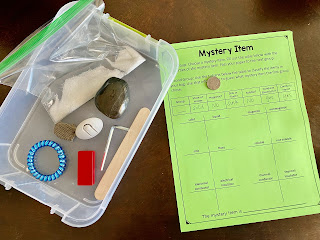
This activity gives each group a box of items where they will pick one item and classify it based on the properties given on the sheet. 


Each group will pass their box of items and their classification for the mystery item to the next group. The group will have to use the table the previous group filled out based on the physical properties of the object to guess what the mystery item is. 


Download the free activity here. 


I have included a list of potential items that you can place in the box. I went through the last several years of the 5th grade science STAAR test to see which items they use in their questions.


Classifying Matter Properties of Matter


Monday, January 24, 2022

Order of Operations Error Analysis Math Activity--Free Order of Operations Activity

 How to Practice Order of Operations?

Students love finding mistakes, especially mistakes the teacher or their peers make. I always had a tally on the board of how many mistakes that I made in math class. Finding mistakes is a higher level thinking skill because students have to understand the concept enough to be able to find where something went wrong.

One of my favorite activities for order of operations was having students look for errors when it came to solving the expressions. You can do this with little prep as long as you have a few order of operations problems and some dry erase markers like in this post

I also put together this presentation for 5th grade math. Each slide has an order of operation problem solved with two different answers. Students have to find which one is correct and you can take it a step further by ask him to find what mistake did someone make to get the wrong answer.
Order of Operations Error Analysis Free Resource--Click Here


Now students are quick to find mistakes of their peers and their teachers, but when it comes to finding their own mistakes it can be a struggle. But however if we continue to expose them to common misconceptions and common mistakes and point them out hopefully they will remember them when they are solving problems on their own.

Here are some other resources for order of operations that you might be able to use. 


Friday, January 14, 2022

Fractions as Division Lesson-Introduction to Different Representations of Division

How to teach Fractions as Division?

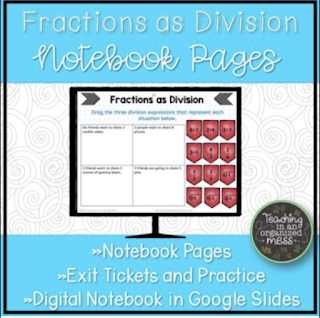
One of the first lessons that I taught in six grade math was fractions as division. Getting students to understand that a fraction is also a division problem is a year-long struggle so introducing an early is necessary so that we can keep practicing it over and over and over again. 


I will admit that at the beginning of my career for teaching math, I was not too big on emphasizing math vocabulary. It’s one of those things that I will regret not doing well with my first class. For this lesson, emphasizing the vocabulary for division problems is super important to help students keep what number is what in a division problem. 

Remember from this post, that the best math lessons have students connect with the new learning with something that they already learned in the past. So we discuss vocabulary and look at the division representations that they already know using the division sign and the “house”. I have my students repeat over and over again which number in the problem is the dividend and which number in the problem is the divisor. Then we look at a fraction and students learn how the numerator is the dividend and the denominator is the divisor.

As we are setting up 3 representations of division, we repeat the vocabulary again. By the end of the lesson they are sick of saying the words dividend and divisor but repetition is key here.
   
This presentation is a jumping off point for a fraction as division lesson. From here I would continue to give students real world examples of division and have them write a division representations for those examples.

What are some common misconceptions with fractions as division?


One common misconception that students have is that the bigger number must always be the dividend. This is something that an elementary school teacher probably told them as an easy way to get them to remember to put the bigger number inside the house. This is a habit that middle school teachers have to help students break.

What is next with teaching fractions as division?


I have some other fractions as division resources available in my store. 

  • Here is a free puzzle where students need to match a real-world situation with the 3 division representations. 

Fractions as Division Puzzle
Fraction as Division Practice

Wednesday, January 12, 2022

5th Grade Math Coloring Pages-Easy Sub Plans for 5th Grade

What to do for 5th Grade Math Sub Plans?

Planning for a teacher absence is quite possibly the worst. So much planning goes into making sure the kids are engaged in activity and a substitute, who may or may not have any teaching experience, is able to get through the day.  When the absence is unexpected, it is nice to have some go to activities to print and copy for an easy substitute plan.

Do 5th Grade Students like Coloring Pages in Math?


One thing my students grumbled about the least was math coloring pages. They still had to practice some math, but they got a color at the same time.


I wish I had had a coloring page for every math topic last year for the days when teachers had unexpected absences and they were out. I created a coloring page for each set of topics in fifth grade math.


5th Grade Math Coloring Pages


Converting Measurements Math Coloring Page


Thursday, December 16, 2021

FREE Classifying Rational Numbers Lesson and Activities

How to Teach Classifying Rational Numbers?

I love teaching classifying rational numbers. I don’t know why I like it so much but I think part of the reason is that the students already know pieces of this lesson and I am just helping them connect things they’ve learned in math previously to this new skill.

Classifying Rational Numbers Lesson Preview

The best math lessons are the ones were students make connections to something they have learned before. Research shows that when students are able to make connections to things that they already know, then those new topics stick in their brain better.


This set of classifying rational number lessons has students use number lines and come up with their own definition of things like whole numbers, which they have been using since kindergarten.


This lesson plan was originally written to be used within a classroom that uses small groups. So you will see four days of lessons that should take 15 to 20 minutes each and then the teacher would pull small groups for intervention or extra practice on this topic. However, you could also condense the lesson into 2 to 3 days depending on the length of your class period. 


You can download the set of lessons here for free. The lesson plans are editable and there is also a set of activities that go with the lesson plans.


How to Practice Classifying Rational Numbers?


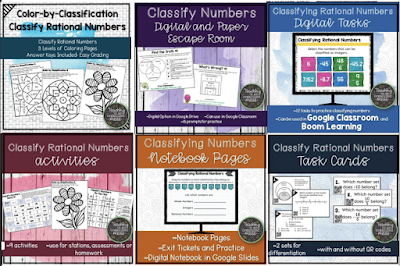
If you would like more ways to practice classifying rational numbers, I have tons of resources in my TPT store. I would use these additional resources for extra practice throughout the year, for homework, for substitute lesson plans, or for stations in a small group math classroom.


Classifying Rational Numbers Activities


Sunday, January 3, 2021

Introduction to Inequalities with Desmos and Real-World Situations

 I think introducing inequalities is so much more interesting and fun than equations. There are so many more real-world situations that students can relate to. 

"Your mom says she will give you no more than $20 for lunch this week. How much money could she give you?"

"You need to be at least 48 inches to ride the roller coaster. How tall could you be and still ride it?"

"The elevator can hold up to 750 pounds. How much can the elevator hold?"

You can have some fun discussions with your students and even those students who struggle with math can participate because it is something they can relate to. It is  great way to help students build confidence. Math isn't just a set of steps and algorithms--its a way to explain the world around us. 

So this year, I was in the classroom because of lack of substitute teachers and got to start the inequality unit with some 6th graders. These are the two activities I used with students. (My campus currently has enough devices for every student.)

1. Desmos Inequalities on a Number Line

Have you used Desmos? You might know it as an online graphing calculator, but it is so much more. There are lessons on there that you can walk students through, see what they are doing in real-time, and give immediate feedback. 

The assignment I have linked has students place value on the number line with prompts like "a number less than 3." This starts students thinking about how there are multiple numbers that fit that prompt. One class would only every pick whole numbers and I had to push them to see 1.5 as a value they could select. 

Eventually this assignment shows students how we use a shaded number line to show all possible solutions. 

2. Google Slides Beginning Inequalities

Next, I had students look at some real-world statements on the board and place possible solutions on the number line. I had several students come up to the board and use a marker to mark their possible answers. Again, all students were able to participate because theses were situations they experienced in their daily lives. 

Now I know that when we get into solving and writing inequalities, that students may struggle. But by starting the unit with some low floor activities, the students can build their confidence and it is something I can continue to refer back on. 


Friday, September 18, 2020

Modeling Adding Integers with Algebra Tiles Free Google Drive Resource

 Virtual. Learning. 

Remote. Learning.

Distance. Learning.

Online. Learning.

Whatever your district calls it--this isn't easy. Not that I expected it to be. But this is just so much harder than I thought. There are so many decision to be made as new circumstances come up. I worry that our online learners aren't getting what they need. I worry about our in-class learners. I worry about my math teams and the stress they are under. I am constantly worrying. 

Hopefully in a year we can all look back on this time glad that school is filled with students talking, laughing, not on the computer all day long, etc. 

We've been working on our integer operations lessons. I filmed a video today with my favorite lesson that really needs students talking to work! I was just sitting at my desk talking to myself about the excitement that is integer operations <--that is not sarcasm. 

I love algebra tiles so much. When I first learned out them 7 years ago, I loved them. Where were these when I learned algebra, where all my math problems began!

If you aren't using algebra tiles or colored counters to teach integer operations--start now. 

This assignment has students model simple addition expressions, create zero pairs, and simplify the expression. 

Modeling adding integers with algebra tiles free google drive resource


Click here to copy the activity into your Google Drive. 

Modeling adding integers with algebra tiles free google drive resource


Sunday, September 6, 2020

Using Integer Vocabulary to Get Students to Talk in Math | Free Resource

I don't like just introducing new concepts in math without talking about real-world implications. When introducing integers, we start with talking about vocabulary that show positive and negative situations. 

Integers Vocabulary

On the day you introduce integers, display this slide to your class and ask them to pick one word with their group that means positive and one that mean negative. 

Having your students talk in math class is important. Not just to explain math, but to build skills of sharing ideas in respectful ways with their classmates. This is a low floor questions where most students will be able to find at least 1 word that they can explain as positive or negative. It is also important for ELLs to practice their academic vocabulary with their peers. 

Talking in math class doesn't always have to be about explaining how to solve a problem. This is still math talk! It will also help students be able to connect math class to outside the classroom. 

You could even extend this to a writing activity and have students write what about the words their groups talked about. 


Wednesday, September 2, 2020

Fraction Decimal Percent Google Slides Digital Assignment

 Are you are trying to figure out virtual learning and face-to-face learning at the same time? Is your school doing just virtual learning? No matter what your situations, the 2020-2021 school year will be one to remember. The first few weeks of school have been exhausting and overwhelming. 

I want to do what I can to help. I wish I could do more! 

This resource has students look at models and name the fraction, decimal, and percent modeled. 

Fraction Decimal Percent Models

Click here to download to the Free Activity

Fraction Decimal Percent Digital Task


Friday, August 28, 2020

Expanded Notation Dice Game Elementary Math Station

 When I first started implementing math stations in my classroom, I tried to make every station elaborate and I quickly burned out. I was explaining stations to students all the time instead of making use of that time to pull small groups. So, I have searched and made stations that are easy to implement, easy for students to do while still helping them practice the skill I want them to practice. 

Expanded Notation Math Station

This Expanded Notation Dice Game is easy to implement, easy for students understand the instructions while helping them practice writing numbers in expanded notation. 

Expanded Notation Math Station


Thursday, August 27, 2020

Multiply or Divide Decimals Word Problem Sort | Google Classroom Resource

I have learned a lot about using Google Drive to create resources for math the last few months. My district does not use Google Classroom, but we do use an LMS that allows Google Drive resources to be assigned. 

When students read word problems, they may struggle with deciding on what operations to use. Throw some decimals in there, and some get really confused. 

I made this sort in Google Slides. It has 10 word problems which similar situations. Students have to sort them into columns based on whether they will use multiplication or division to solve. 

Multiply and Divide Decimals Word Problems

When I introduce this topic to students, I ask them to do 2 things. 

1. Replace the numbers in the word problem with whole numbers. Does that make it easier to decide the operation to use?

2. Look for the Total. Do you have the total? Or are you looking for the total? If you have the total and you are splitting it into equal groups, it is division. If you are looking for the total and you have equal groups you need to combine together to get the total--its multiplication. 


Multiply and Divide Word Problems Sort

Friday, May 29, 2020

Rounding Decimals Using a Number Line Free Lesson and Activities


When I was in school, I always felt that rounding decimals and estimating numbers was a waste of time. That’s because nobody ever explain to me how rounding and estimating could help me solve problems. There is a lot of math that needs to be precise in the real world however I find that most the math I do on a daily basis can be an estimate. I think that rounding and estimating help students become flexible with numbers. 

The lesson that I am sharing today is rounding decimals. This is a topic that students have previous practice when they learned how to round whole numbers. The Texas TEKS 5.2C reads “round decimals to tenths or hundredths.” The common core standard reads “use place value understanding to round decimals to any place.” 

Most of us have probably heard a rhyme that similar to “Five or more? Raise the score. Four or less? Let it rest.” I am not 100% opposed to teaching students a rhyme, however I think students need to understand why the rhyme works. If students aren’t able to connect the rhyme to anything they will be less likely to remember it. This lesson uses number lines to help students round. The last lesson I share, comparing decimals, also used number lines. Number lines are becoming one of my favorite math tools because they help students become more flexible with numbers. I will try to incorporate them as much as possible. 

You can download the lesson and activities here.  The lesson plan is in editable form for you to change as needed. 


Friday, May 22, 2020

Reviewing Previous Skills: Beginning of the Year 5th Grade Stations

The school year is over or almost over and I'm planning for next year. This year I want to focus on reinforcing skills that students learned from the previous year that directly scaffold into the next year's standards. I work with 5th and 6th graders so I looked at 4th and 5th grade TEKS and made a list of the ones I could easily make a station, that directly scaffold the next grade level, and hopefully combined a few skills. 

At the beginning of the year, I set up stations that I wanted students to get used to so that I could do the same station and just switch out the topic. I also started with skills that student's generally excel at. I want them to feel successful at the beginning of the year so we all start the year with a good attitude about math. 

This set of stations is Bump It games for 5th grade. This is a fun, easy game for students to play and they can get a bit competitive and still practice. 

The skills I included are:
  • Dividing Whole Numbers: Up to 4 digit dividend and 1 digit divisor
  • Finding Perimeter with Whole Numbers
  • Equivalent Fractions
  • Finding Area of Rectangles with Whole Numbers
These are skills that "should" (coronavirus) have been taught in 4th grade and are definitely skill students need to use in 5th grade. If we get to use these in the classroom this fall, I would suggest doing a quick mini lesson or warm-up a few days before playing the game. Something to jog student's memories. 


I love these dry erase sleeves for students to write on during stations. It erases much easier than lamination and stays around longer than sheet protectors. (As an Amazon Associate I earn from qualifying purchases.)

Friday, May 15, 2020

Comparing Decimals to the Thousandths Free Lesson Plan and Activities


The lesson that I am sharing today is comparing in ordering decimals to the thousandths. In previous grade levels, students have compared and ordered decimals using models and they compared and ordered whole numbers using <, >, and =. This standard scaffolds into higher grade where students need to compare and order all rational numbers. Since rational numbers can be converted into decimals if students have a strong foundation and understanding decimals in their value than it will help them with the higher level comparing. 


The TEKS this lesson covers says "compare and order decimals to thousandths and represent comparisons using symbols >,<, and =."  The common core standard states "students will compare two decimals to thousandths based on meanings of the digit in each place using >, <, and = symbols to record the results of comparisons."

When you work with students comparing in ordering decimals you see what types of misconceptions they have pretty soon in the lesson a lot of students may feel that 0.49 is less than 0.432 because the second number has more digits. 

Anytime students are comparing two numbers I like to use a number line. Students have used number lines before and have placed numbers on the number line and I believe it is important for them to be familiar and fluent with how to place numbers on a number line. You can start by providing students with teacher created number lines but I think it is more beneficial for students to eventually create their own number lines. This lesson begins with students looking at a number line and placing numbers on the number line. 

You can download the lesson for free here. I left the actual lesson plans in Word form so you can edit it as need. 


If you would like any more resources for comparing decimals to come back to this topic for review throughout the year, you can check out these items in my TpT store. 


Tuesday, May 12, 2020

Decimal Place Value: Writing Decimals with Expanded Notation Free Lesson

Place value is such an important topic to make sure that students understand. 

It’s usually the first topic of the school year and sometimes it gets glossed over because the students easily complete the place value tasks they are given. However we need to make sure students truly understand place value. 


One of the first math lessons of the year for a Texas 5th grade student is writing decimals in expanded notation. The TEKS reads that "students will represent the value of the digit in decimals through the thousands using expanded notation and numerals." Expanded notation was first introduced to students in third grade and in fourth grade they wrote numbers in expanded notation through the hundredths. In fifth grade we are adding writing numbers using expanded notation through the thousandths. 

This is not a lesson I would spend more than 2 to 3 days on because you can spiral it throughout the year in warm-ups and homework and in-class station. The lesson I’m sharing with you today has the following components: 
  1. Activates prior knowledge by asking students to read and write numbers 
  2. Has a pre-assessment to determine where students are at with writing expanded notation 
  3. Introduces the thousandths place value using a place value mat 
  4. Gives opportunities to practice writing expanded notation and writing numbers in standard form from expanded notation with a station, assessment, and practice.


Each day's lessons are short but can also be extended if needed. I always jump into math lessons by the second or third day of school and continue to teach my routines and expectations through the lessons I am teaching--post about that coming soon. 

Here are some more place value resources available in my TpT store to be used for extra practice throughout the year. 


Wednesday, April 15, 2020

Free Digital Resources for Math to Use for Remote Learning


"This is crazy."

Something my current co-worker (my husband) and I said to each other several times a day at the beginning of this social distancing. Now, we mostly have settled into a schedule and it seems "normal" that we just stay home all the time. My kids haven't seen the inside of anywhere except their house in over a month. No church, no school, no dye-jobs (my poor gray roots). We are making it.

Transitioning to remote learning has been a learning curve. I have learned a lot about my school's LMS and Google Classroom and Boom Learning and Seesaw! So many tools to learn quickly for the students at my school and my own daughter's school work.

At the beginning of this, the other instructional coach and I worked quickly to get packets made and lessons up on our Canvas website. It was extremely helpful to turn to resources other teachers had shared. I would like to return the favor.

As much as my schedule will allow--(working from home, teaching a kindergarten, keeping a toddler entertained, and parenting), I am trying to create some quick digital resources that can be assigned virtually to students.

Check this space to see all my free digital resources . I will added free resources to this as I get finish them. Here are a few that are included.


Related Posts Plugin for WordPress, Blogger...