Showing posts with label Pictures. Show all posts

Wednesday, December 16, 2015

Notebook Pages

I am really happy with how the Math ISNs are going this year. The students are taking ownership of them. I have had two students lose theirs and one student spilled water on his, but all three have wanted to redo their notebook so it has everything in it. 

Most of the pages I come up with are me thinking quickly what the students will benefit the most from. I try not to make too many copies for the notebook. I asked the students one day if they just want to write stuff down in it, or do they like the construction paper and color. They like the construction paper and color. I think it is a more fun way to take notes, it is visually appealing, AND it makes the notes easier to read. 

Here are some pages from the last few weeks. 


Friday, September 25, 2015

Shopping Spree-Multiplying Decimals

I used newspaper ads the to have students practice multiplying decimals.

Their instructions were to find at least 5 items from the ad to purchase. They had to purchase more than 2 of each item. Then use multiplication to find out their total cost.

For the next time I do this project, I will give students an amount of item to buy. For example, I will ask them to purchase 4 of one item, 15 of another item and so on. So they get practice multiplying with a variety of numbers.


Monday, March 17, 2014

Metamorphosis Research

Last week, I shared the beginning of our metamorphosis unit. In the years past, the first lesson was writing down vocabulary and taking notes on each type of insect life cycle. I wanted to do something a bit different.

I am lucky to have some Window 8 tablets in my classroom. It isn't enough for every student, but I allowed them to bring their own tablets to use so we would have enough.

The task was to discover what the steps to complete and incomplete metamorphosis are. I found this website which another teacher put together. The students were to find two insects that go through complete metamorphosis and two insects that go through incomplete metamorphosis. As they found the life cycle of their insects, they needed to draw and label the stages.


As the students worked, I walked around asking them to describe their insects life cycle. Most were able to and it allowed me to see who still wasn't sure about it. Afterwards, they wrote a story about one insect and what its life is like, as it goes through each stage in the life cycle. This is where I need to fix my instructions. I wanted the students to be creative, but most just wrote an expository essay. Which is okay, just not the intent.

The next day, the students talked in groups to each other about life cycles and answered some multiple choice questions together. The goal of this activity was to have students talk to each other without looking to me for approval.

I was happy to see that double the amount of students passed this science test compared to the last one!

Friday, March 14, 2014

Mealworms and Beetles! Oh My!

I am trying to incorporate my inquiry-based learning in my classroom this year. It is a really fun way to teach and the students usually have more fun. However, this type of instruction is new to them, so we are working on having fun while learning. 

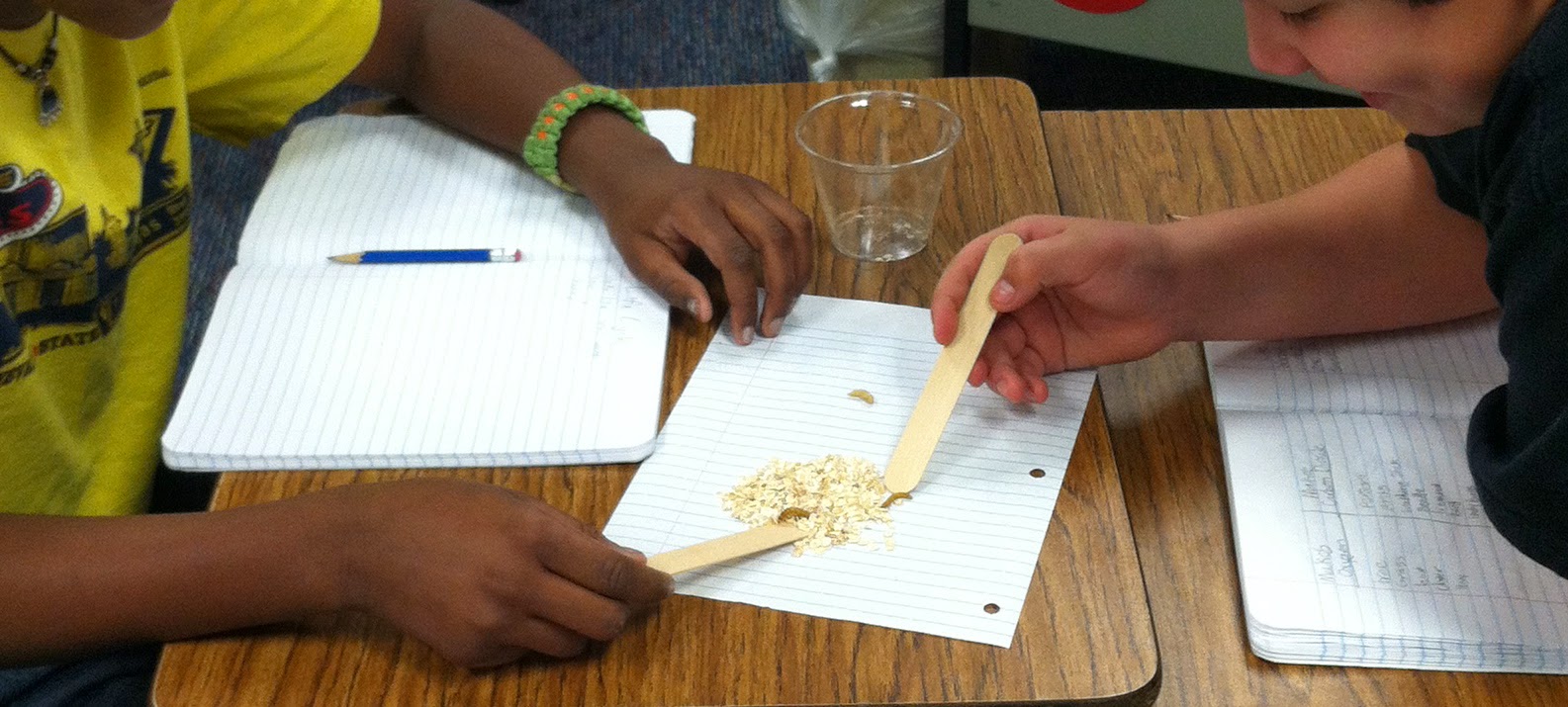
In 5th grade in Texas, Students need to describe the differences between complete and incomplete metamorphosis. To begin this lesson, I dumped a cup on every group's desk containing mealworms and pupae. I asked students that if they knew anything about the insects, that they were not to say anything to take away someone else's discovery. (We talk about this often throughout the year. It isn't fair to take away someone else's learning opportunity. This frustrates the kids who know everything and really want to tell everyone else.) Students were also reminded that these were living creatures no matter how small and need to be treated with respect. 

After dumping out the cups, there were squeals and screams.  Some students refused to get close to the insects, others got their nose right in there. 


As the were observing the insects, the students were asked to write down any observation they had. This is where I have a lot of students ask "Is this okay?" or "Can I write this down?"It is hard to get them to understand, that most of the times, if they think it, it is okay to write it down.

Then we shared our observations. This was my favorite part. Getting students to communicate can be difficult, but with a bit of probing, they are getting better at it. Some of their observations (and inferences) were:

  • They look dead. (It is still and doesn't move when touched)
  • It looks pregnant. (It is swollen in one place, like a pregnant person)
  • It has 6 legs. (So it could be an insect)
  • It has a hard outside.
  • Some are brown, some are white.
  • It looks like it is in a shell.
Sometimes, I had to press students to explain what they meant. At the beginning of the year, I would get shrugs when they were asked to explain more. Now they are using more adjectives and describing more. I am glad that they are now talking more. 

I was careful not to give any terms or vocabulary. But some students predicted that the mealworm turned into the pupae and then into a beetle. Others thought it was the other way around. I kept the mealworms and pupa in the classroom all week and I had some beetles in another container that we continued to observe. The next day, a pupa started "hatching" from the pupa. The students were excited to see a life cycle in work!


Thursday, July 19, 2012

G-Camp Update

I have only been at g-camp for 5 days, but it feels so much longer. Each day is jammed with geology sites and activities which starts at 6:30am. Things most people might take one full day to do, we are doing several per day.

Currently, we are touring Colorado. The mountains are beautiful. There is nothing like them in East Texas. And now, I kind of know more about them. Before it was just a mountain. But now it can be a mountain surrounded by rock glaciers, with a few dikes or hogbacks and alluvial fans at the bottom.

Learning this stuff myself does remind me of how some things must seem to students in our classes. I came into this knowing very little about geology. And it has taken me 5 days to catch on to some things. Sometimes I feel like the professors are speaking gibberish.

But I am working hard, doing my homework, and reading the night before.

These are some things I have seen so far.

These are the Great Sand Dunes of Colorado. To me, they kind of seem like they shouldn't be there. And this picture does not do it justice. The highest dune is around 731 feet. People seem like tiny dots compared to them.


The Black Canyon of the Gunnison in Colorado. The Empire State Building would only come up to about half of the cliff. This was the first real canyon I have seen. It was absolutely gorgeous.


Lake San Cristobal in Colorado. This lake is in a caldera. Which is a landform. Who knew there were so many different types of landforms. A caldera is a crater that occurs after the magma comes out a volcano. The magma leaves a void and then the crust collapses in and a caldera is left. This specific caldera is actually miles in length and width.

The Continental Divide. Something I learned about forever ago and now I have finally seen. 

There are still 12 days left in this and I don't think the "good" stuff has started yet. Although, I consider this good stuff.
Related Posts Plugin for WordPress, Blogger...