Wednesday, April 15, 2020
Free Digital Resources for Math to Use for Remote Learning
"This is crazy."
Something my current co-worker (my husband) and I said to each other several times a day at the beginning of this social distancing. Now, we mostly have settled into a schedule and it seems "normal" that we just stay home all the time. My kids haven't seen the inside of anywhere except their house in over a month. No church, no school, no dye-jobs (my poor gray roots). We are making it.
Transitioning to remote learning has been a learning curve. I have learned a lot about my school's LMS and Google Classroom and Boom Learning and Seesaw! So many tools to learn quickly for the students at my school and my own daughter's school work.
At the beginning of this, the other instructional coach and I worked quickly to get packets made and lessons up on our Canvas website. It was extremely helpful to turn to resources other teachers had shared. I would like to return the favor.
As much as my schedule will allow--(working from home, teaching a kindergarten, keeping a toddler entertained, and parenting), I am trying to create some quick digital resources that can be assigned virtually to students.
Check this space to see all my free digital resources . I will added free resources to this as I get finish them. Here are a few that are included.
Wednesday, November 13, 2019
Density Cube Lab
Do you have these Density Cubes in your school building?
My first year of science coach I found these density cubes in the science lab and in teacher's cabinets off mixed up. Some of them were easy to tell what was what, but for others I did exactly what I would want students to do. I knew what the volume was so I measured the mass and then calculated the density and labeled all the cubes with numbers. (It took forever.) Then I begged science teachers to keep them organized so we didn't have to do it again.
Here is a lab sheet for students to do the same process. They find the mass and volume and then calculate the density to identify what each cube is made of.
**As an Amazon Associate I earn from qualifying purchases.
My first year of science coach I found these density cubes in the science lab and in teacher's cabinets off mixed up. Some of them were easy to tell what was what, but for others I did exactly what I would want students to do. I knew what the volume was so I measured the mass and then calculated the density and labeled all the cubes with numbers. (It took forever.) Then I begged science teachers to keep them organized so we didn't have to do it again.
Here is a lab sheet for students to do the same process. They find the mass and volume and then calculate the density to identify what each cube is made of.
The measurements do not have to be 100% exact. (Well, volume can be, make sure they are measuring in centimeters)
If your triple beam balances are like ours, they may not be exactly calibrated. Things may be off by a few grams which is why the known densities have a range.
**As an Amazon Associate I earn from qualifying purchases.
Monday, November 11, 2019
Magnetism Lab
I'm here to share an idea for students to explore magnetism.
Magnets are something that students have seen since kindergarten. By the time they get to 5th grade, most know that some things are attracted to a magnet.
The biggest misconception I've seen is students thinking that all metals are magnetic.
To set up this lab, collect a variety of objects. Make sure to included metals and nonmetals, and included both metals that are magnetic and non magnetic.
This a is a lab where the teacher should do very little. You supply the materials, tell students to predict if an object is magnetic, and then test it.
Here is a lab sheet for students to fill out as they experiment.
After the students finish testing the items, ask them if they can determine if an object is magnetic or not without using a magnet.
You want the students to at least get to the point where they say only metals are magnetic--but not all metals.
Share with students what the metal objects are made of. Can they find a pattern and determine what makes a metal magnetic?
Magnets are something that students have seen since kindergarten. By the time they get to 5th grade, most know that some things are attracted to a magnet.
The biggest misconception I've seen is students thinking that all metals are magnetic.
To set up this lab, collect a variety of objects. Make sure to included metals and nonmetals, and included both metals that are magnetic and non magnetic.
- Some objects made of metal that are nonmagnetic: penny, key aluminum foil.
- Some objects made of metal that are magnetic: paper clip, an iron nail, iron filings
- Also include various non-metal items: marble, rubber band, plastic toy, etc.
This a is a lab where the teacher should do very little. You supply the materials, tell students to predict if an object is magnetic, and then test it.
Here is a lab sheet for students to fill out as they experiment.
After the students finish testing the items, ask them if they can determine if an object is magnetic or not without using a magnet.
You want the students to at least get to the point where they say only metals are magnetic--but not all metals.
Share with students what the metal objects are made of. Can they find a pattern and determine what makes a metal magnetic?
Saturday, November 9, 2019
Addition and Subtraction Doubles--Basic Fact Fluency
We needed some help with basic addition and subtraction. Any math teacher will tell you that when students struggle with basic computation, it is difficult for them to learn more advanced skills.
These two activities focus on doubles. It can be used as a station for students for student to practice together.
Download this for free here.
Sunday, October 6, 2019
Free Subtraction with regrouping Tic-Tac-Toe
I was in a classroom this week and the students were learning how to divide with 2-digit divisors. Over and over, I saw students get wrong answers. As I looked over their work, the problem wasn't that they didn't know the steps to division. They were having problems subtracting, especially when they had to re-group.
Even though this was a 5th grade classroom, it is always necessary to fill in gaps that students have. If students can't subtract without making lots of mistakes, they can't divide. Even students who were dividing using the partial quotients method have to divide.
I made this quick tic-tac-toe game for the teacher to use so students can practice subtracting without using just a worksheet.
Download it for free here.
Even though this was a 5th grade classroom, it is always necessary to fill in gaps that students have. If students can't subtract without making lots of mistakes, they can't divide. Even students who were dividing using the partial quotients method have to divide.
I made this quick tic-tac-toe game for the teacher to use so students can practice subtracting without using just a worksheet.
Download it for free here.
Are there gaps that you see in your grade level that you have to go back and teach again or have students practice? What are they?
Sunday, July 21, 2019
Science Coloring Pages to Use in Stations or Homework
The science teachers at my school started small groups this year and wanted things for students to do in stations as they pulled students into small group. I had a made a coloring page one and they requested more. So I started making some coloring pages for them. The students like doing them. There are something students can complete without interrupting the teacher at her small group and they enjoy coloring--even in middle school. Not every student likes to color...but that's okay.
Here is a free coloring page for students to differentiate between elements and compounds.
If you are interested other science coloring pages. The topics there so far are calculating density, heat energy transfer, metals nonmetals and metalloids, rock cycle, classification of organisms, and plate boundaries.
Saturday, July 20, 2019
Statistics--Finding Mean, Median, Mode and Range with Your Name
Statistics is one of my favorite units to teach. It is something every person should understand. It is used against voters and consumers all the time and we should be able to recognize when the statistics aren't really saying what we're being told they are saying.
In a statistics class in college I had to read the book Damned Lies and Statistics. It was eye-opening to see how bad statistics can be used influence people.
I explain all of this to my students when I start our statistics unit. We only spend about 3 weeks on it, and its usually the end of the year, but its a unit students usually enjoy.
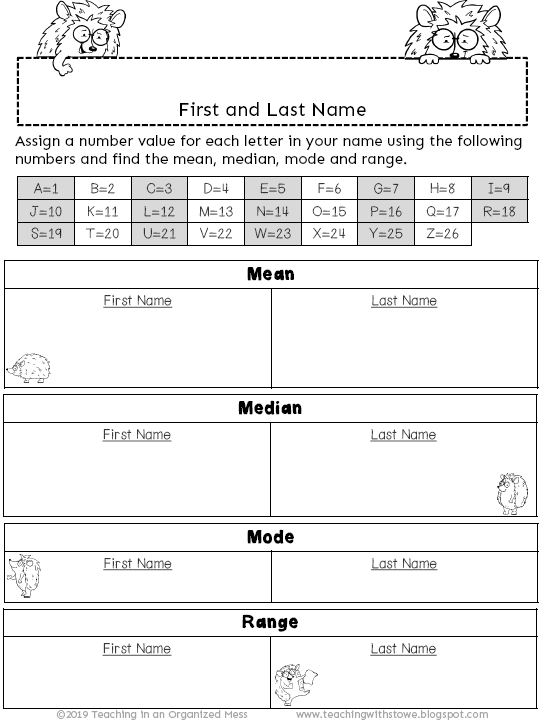
I wanted to share a freebie with you today. I gave this to students for homework. Students use their name, turn the letters into numbers, and then calculate the mean, median, mode, and range to their names.
Name Mean, Median, Mode and Range
In a statistics class in college I had to read the book Damned Lies and Statistics. It was eye-opening to see how bad statistics can be used influence people.
I explain all of this to my students when I start our statistics unit. We only spend about 3 weeks on it, and its usually the end of the year, but its a unit students usually enjoy.
I wanted to share a freebie with you today. I gave this to students for homework. Students use their name, turn the letters into numbers, and then calculate the mean, median, mode, and range to their names.
Name Mean, Median, Mode and Range
Students like it because it is their own name so it is a little less headache to get them to complete it.
If you are interested in other statistics resources I have some in my store.
**This site contains affiliate links to products. I may receive a commission for purchases made through these links.***
Subscribe to:
Posts (Atom)