Showing posts with label Metamorphosis. Show all posts

Sunday, August 19, 2018

Change in Science TEKS and Metamorphosis Foldable

The science TEKS have been streamlined this year. Our district has done a lot of work to make sure that teachers are aware of the changes and not teach old lessons without making sure they fit the streamlined TEKS.

If you haven't used the resources on Lead4ward and you teach in Texas, you should. I am constantly on this website for various resources, the one I am sharing with you today takes the old TEKS and compares them with the streamlined TEKS. To find it, go here and click on the appropriate side-by-side for your grade level.

One thing that 5th grade does not have a TEKS for anymore is complete and incomplete metamorphosis. However, if you look at this document it states "Impact: the term metamorphosis has been removed from the K-12 TEKS (implied it will be addressed in standards pertaining to life cycles of living organisms that undergo metamorphosis)". There is still a 3rd grade TEKS that discusses life cycles that can still be tested on the 5th grade STAAR. So...will it not be on the STAAR test? I think it is possible.

So, here is a science notebook foldable that goes with metamorphosis, available for free on my TPT store.

Monday, March 17, 2014

Metamorphosis Research

Last week, I shared the beginning of our metamorphosis unit. In the years past, the first lesson was writing down vocabulary and taking notes on each type of insect life cycle. I wanted to do something a bit different.

I am lucky to have some Window 8 tablets in my classroom. It isn't enough for every student, but I allowed them to bring their own tablets to use so we would have enough.

The task was to discover what the steps to complete and incomplete metamorphosis are. I found this website which another teacher put together. The students were to find two insects that go through complete metamorphosis and two insects that go through incomplete metamorphosis. As they found the life cycle of their insects, they needed to draw and label the stages.


As the students worked, I walked around asking them to describe their insects life cycle. Most were able to and it allowed me to see who still wasn't sure about it. Afterwards, they wrote a story about one insect and what its life is like, as it goes through each stage in the life cycle. This is where I need to fix my instructions. I wanted the students to be creative, but most just wrote an expository essay. Which is okay, just not the intent.

The next day, the students talked in groups to each other about life cycles and answered some multiple choice questions together. The goal of this activity was to have students talk to each other without looking to me for approval.

I was happy to see that double the amount of students passed this science test compared to the last one!

Friday, March 14, 2014

Mealworms and Beetles! Oh My!

I am trying to incorporate my inquiry-based learning in my classroom this year. It is a really fun way to teach and the students usually have more fun. However, this type of instruction is new to them, so we are working on having fun while learning. 

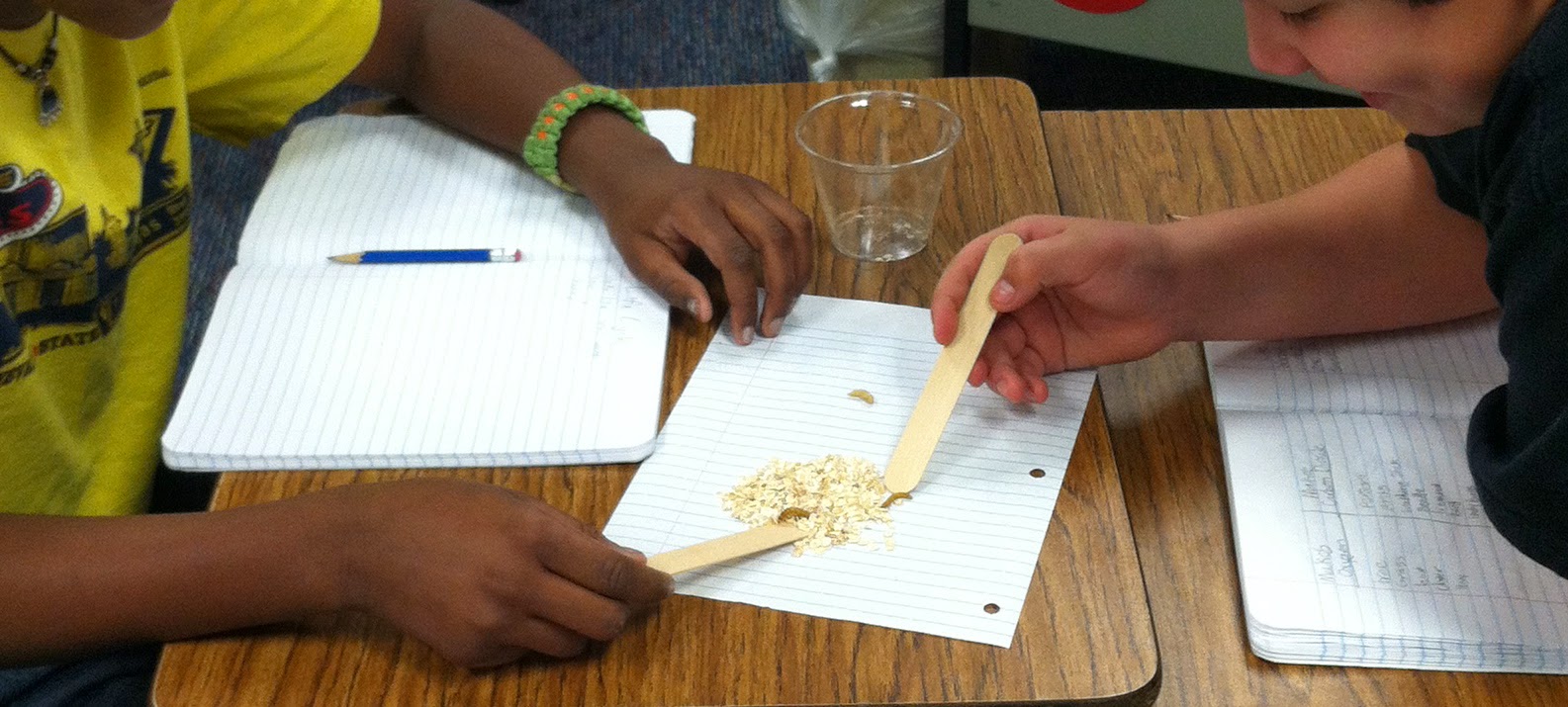
In 5th grade in Texas, Students need to describe the differences between complete and incomplete metamorphosis. To begin this lesson, I dumped a cup on every group's desk containing mealworms and pupae. I asked students that if they knew anything about the insects, that they were not to say anything to take away someone else's discovery. (We talk about this often throughout the year. It isn't fair to take away someone else's learning opportunity. This frustrates the kids who know everything and really want to tell everyone else.) Students were also reminded that these were living creatures no matter how small and need to be treated with respect. 

After dumping out the cups, there were squeals and screams.  Some students refused to get close to the insects, others got their nose right in there. 


As the were observing the insects, the students were asked to write down any observation they had. This is where I have a lot of students ask "Is this okay?" or "Can I write this down?"It is hard to get them to understand, that most of the times, if they think it, it is okay to write it down.

Then we shared our observations. This was my favorite part. Getting students to communicate can be difficult, but with a bit of probing, they are getting better at it. Some of their observations (and inferences) were:

  • They look dead. (It is still and doesn't move when touched)
  • It looks pregnant. (It is swollen in one place, like a pregnant person)
  • It has 6 legs. (So it could be an insect)
  • It has a hard outside.
  • Some are brown, some are white.
  • It looks like it is in a shell.
Sometimes, I had to press students to explain what they meant. At the beginning of the year, I would get shrugs when they were asked to explain more. Now they are using more adjectives and describing more. I am glad that they are now talking more. 

I was careful not to give any terms or vocabulary. But some students predicted that the mealworm turned into the pupae and then into a beetle. Others thought it was the other way around. I kept the mealworms and pupa in the classroom all week and I had some beetles in another container that we continued to observe. The next day, a pupa started "hatching" from the pupa. The students were excited to see a life cycle in work!


Related Posts Plugin for WordPress, Blogger...