Showing posts with label Resources. Show all posts

Thursday, February 28, 2019

Rock Cycle Resources

Teaching the rock cycle can be fun. Even though it is a real-life process that takes millions of years to observe, there are many ways to model the rock cycle.


This lab uses chocolate, butterscotch, and white chocolate chips to model sedimentary, metamorphic, and igneous rock formation.

If you have some broken crayons (what teacher doesn't), this lab uses crayons to model the three types of rock formation.

Love starburst? This lab uses starburst to model the processes.

(I did not create any of these lab. I just found them on the web.)

Types of Rocks Foldable


Digital Types of Rock Sort on Google Drive


This interactive webpage overviews types of rocks and the formation. There is also a little quiz at the end. 


Tuesday, January 22, 2019

New Page--Free Resources--Taking Requests


Check out my new page underneath the header --Free Resources--

Anything I post something free on my blog, I will post it there as well so you can see everything in one spot.

Is there anything that you wish you had for your classroom? I'll add it to my to-do list.

Saturday, January 19, 2019

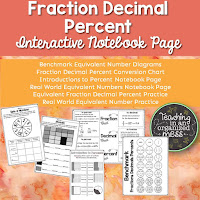
Fraction Decimal Percent--Equivalent Numbers Practice Freebies

I feel like it takes students all school year and then some to remember how to convert between fractions, decimals and percents.

In Texas, we start with generating equivalent numbers in 6th grade: the time when some teachers and students think math manipulatives and models are no longer needed. I strongly disagree. I struggled with math in school (which I believe is what makes me love teaching math now) and I don't ever remember working with math manipulatives or math models. No fraction models, algebra tiles, cuisenaire rods, etc. When I started teaching and understood the models myself, I understood the concepts so much better. The first time I saw dividing fractions modeled with cuisenaire rodes in grad school, I was blown away!

All this to say, don't think 6th graders (or older) are too old for models and manipulatives. Some students may not need them and other will. But don't make that call for them.

When it comes to generating equivalent forms of fractions, decimals, and percents, students have a hard time understanding that the numbers really are equivalent. They are different ways to tell the same story. So I always start with models.

At this point students have worked with fractions and decimals and have probably heard to percents, but don't understand what they are. I start with a mini presentation to get the conversation going about what percents are. (Click the link to make a copy to your Google Drive)


And we practice. Over and over and over again. I use notebook pages like this that students can refer to as they practice.

Practice starts simple. I write fraction, decimals, and percent on index cards, pull students to work in small group, give them so dry erase markers and start converting. They work the problems on the small group table and I get to see where students are running into problems.

Fraction Decimal and Percent conversion is a skill that students revisit all year long, so I need lots of different ways to keep students practicing. Download this sheet here  for more practice. 


Other Fraction, Decimal, Percent Resources


Saturday, November 10, 2018

Calculating Average Speed--FREE Resource

Math and Science are so closely connected, but students never believe it. Ever tried teaching a cross-curricular lesson, only to have students say "This isn't math/science/writing class!" Middle school students start to get a glimpse of how science needs math.

In the Texas Science Standards in 6th grade, students start to calculate average speed given time and distance measurements. Here are a few resources that may help students practice calculating average speed.

ENGAGE

Start by introducing the the formula for calculating average speed by having students hop across the room or take the students outside. Mark off a predetermined distance (like 20 meters, 50 meters...) and give pairs or groups of students a timer to collect their data.


EXPLAIN

Take the Engage activity to a whole new level. Students will need to go outside for this one. Mark off a predetermined distance (50-100 meters) and have students tiptoe, speed walk, and run while they time the members of their group and then calculate their average speed.


MINI-ASSESSMENT

Students should be able to read tables and graphs to calculate average speed. This mini-assessments helps you see if students are able to do that.


Download this for FREE here.

Sunday, November 1, 2015

Prime Factorization

The students started prime factorization this week. 

I was unfortunately sick on Wednesday and ended up missing school that day. It was the first unplanned absence I had in 5 years. It was agonizing on Tuesday night trying to predict if I would feel better the next day. There were many cons to calling in. Mostly, the students would miss a day of new instruction. I had an emergency sub basket all ready with work for them, but it was just practice. Also, I would miss our class picture. In the end, the sickness won and it is good I did stay home. I ended up losing 5 pounds in one day to being sick. I was miserable. 

So my prime factorization lesson seemed rushed as I was trying to make up for a lost day. But I tried to vary the activities the students did, and gave them time to talk about the math. 

We started the lesson with reviewing what prime and composite numbers were. We talked about definitions, debate over which numbers were prime and composite and watched this video.

In one class, we had to talk in length about the difference between a multiple and a factor. 

Then we added a page to our notebook about prime factorization that looked like this. 


The tree flips down and there is another practice factor tree underneath. The students then got a practice sheet to work on with their group which we then checked. 

Afterwards, I gave everyone a dry erase marker and they practiced making factor trees on their desks while I went around checking and asking questions. 

Some common mistakes I saw were wanting to make the prime factorization smaller. Like taking 2x3x5 and wanting to collapse it to 6x5. We would go back to the definition of prime factorization and ask ourselves if all the numbers were prime. Also, some students just did the factor tree and thought they were done. I had to remind them that the factor tree was the process, not the actual prime factorization. 

Next, I will pull students in small groups and practice so I can really who has it and who needs more help. 

One station I will have next week while I pull students in small group is this Prime Factorization Match Up with QR codes. I try to have many of the stations that my students do include instant feedback. I am actually much better at grading this year than I have been in the past, but it is still not same day grading. Students need to know if they are doing it correctly. This way, they can check right away. Plus they'll have an ipad which they still think is cool. 


Thursday, October 29, 2015

100 Minutes to Teach Math!

I have three math classes and each class lasts 100 minutes. It is a ridiculously long time to teach math compared to 50 minutes, but I fill every minute of every class period. I do not know how I could fit everything into a shorter amount of time.

Not every 6th grader loves doing math for 100 minutes. I have to break up the class period with several activities to keep their interest. 

Time
Activity
15 minutes
Daily Math Review

Consists of 4 computation-only problems. The students practice the same types of problem every day for 2 weeks and then they take a quiz. After students work in groups, we grade it together.

This week, students are working on integer operations, exponents, and ordering rational numbers.
30 minutes
Whole Group Instruction

Introduce topics, do whole group activities, add to the interactive math notebook

This is not always direct instruction. Whole group instruction looks different every day. Students may learn about manipulatives (most recently Algebra Tiles). They may also work together to come up with their own rules for the math they are learning.

45 minutes
Math Stations & Small Group Instruction

Students work in heterogeneous groups working on fact fluency, iLearn (a math website that all my students have an account to), and practice skills learned in previous weeks with games, task cards, stations, etc.

While students work, I pull homogeneous groups to work on the new skill introduced in whole group instruction. I have 5-6 groups per class that I pull depending on the class and how much time I have to pull them all.

We do 2-3 rotations in 45 minutes.
10 minutes
Exit Ticket

Practice problems, writing in mathematics, Plickers questions… it varies.
This would be on a normal day. Of course everyday is not perfect. Some days there are tests, or pictures, or field trips. Someday I don't do whole group instruction at all and just do small group instruction. 

Because we spend so much time every day doing math, I don't give a whole lot of homework. Maybe one homework assignment a week, and usually not problems. I like to assign mini-project that students would actually want to do and where they can use their own creativity. 

Tuesday, October 27, 2015

5 Dice

There are so many math apps out there and not all of them are awesome. And some are, but you can only do so much before you have to pay for full access.

5 Dice is a great FREE app that helps students practice all levels of Order of Operation. 
After students choose a level, they roll dice to get their starting number. 

Then they have to create an expression, using all the numbers, to hit the target number. 

Once students hit the target, they are shown the expression they made and how it is simplified. 

My students think it is fun and it is a great way to practice order of operations. 


Monday, September 28, 2015

CHAMPS

My campus is a CHAMPS campus.  It is a classroom management system which includes many ideas for managing a classroom.

My favorite part of CHAMPS is having teachers prevent problems before they start. Putting procedures and expectations in place that prevent the most common classroom problems before they even start. If you are struggling for classroom management (which I would say the area I always have to work hard at), I would suggest looking into the CHAMPS Positive Behavior Support.

I have this poster hanging in my room and the students have a copy in their interactive notebook. It tells students what they are expected to do during each type of activity they will do in math class. I have seen this displayed in different ways, but this was the least amount of work for me.

If you would like to use this, you can get it here in Google Drive. Save it as a Copy and then you will be able to edit as you wish.

Mostly at the beginning of the year, I go over this with students every day before every activity. It is one of those beginning of the school year things that gets tedious, but necessary.
Math Review=Warm up
Guided Math=Small Group/Station Time

My campus also uses Voice Levels that are consistent everywhere. Voice Level 0 is no talking, Voice Level 1 is Whisper, Voice Level 2 is conversation, Voice Level 3 is Presentation and Voice Level 4 is outside. Students need to be taught and shown what voice level is appropriate for each type of activity and what is expected of them.

When we were being trained on CHAMPS, we watched videos from the creator Randy Sprick. He shares an experience with a first year teacher. While observing her in an unruly class, she told her students to stay in their seats and work independently. However, if students needed help, some talked to their neighbor which she allowed, some got up and asked her questions, which she sometimes allowed and sometimes told them to raise their hand and she would come to them. Basically, her expectations changed from one minute to the next and the students did not know what was expected of them.

CHAMPS gives teachers a way to decide on expectations they want to have and share them with the students.

Wednesday, July 3, 2013

Science Notebook Resources

I think my favorite thing about science are the science notebooks!

The student's worksheets, lab sheets, observations, foldables (lots of foldables) all go in there. This is my 4th year doing the notebook and it just gets better every year.

I always hope that by the 3rd day of school, all students have their composition notebooks purchased and brought to school. If not, I always buy extra and they replace mine later on. (Sometimes, but I am particular enough about it being a composition notebook that I will pay for it. My first year, composition notebooks weren't even on our school supply list, so I bought them for the entire class.


For those who do notebooks, you probably already have a process that you use. I want to share some of the resources I have found that might expand what you already do. And get those of you started who haven't done it yet.


Middle School Science has lots of ideas for the Science Notebook- and the actual worksheet to add to the notebook available for download. The page I linked to is mostly 5th grade resources, but I believe I saw 7th grade notebooks there as well. And everything can be adapted to fit what you need.


Another website I found was from the East Bay Educational Collaborative located on the east coast. There are several resources for activities (especially science process skills), rubrics, setting up notebooks, etc. I haven't explore the whole thing yet, but I've already added several things to my lesson plans.

My favorite things here are the Index Master (because after 3 years, I still have not mastered the science notebook index) and the the "Let's be a Scientist" Checklist that students can make sure they are hitting all their steps in reflection and experiments.

Are there any other websites you've found that are great notebook resources? I would love to hear about them!
Related Posts Plugin for WordPress, Blogger...