Showing posts with label TEKS. Show all posts

Friday, May 29, 2020

Rounding Decimals Using a Number Line Free Lesson and Activities


When I was in school, I always felt that rounding decimals and estimating numbers was a waste of time. That’s because nobody ever explain to me how rounding and estimating could help me solve problems. There is a lot of math that needs to be precise in the real world however I find that most the math I do on a daily basis can be an estimate. I think that rounding and estimating help students become flexible with numbers. 

The lesson that I am sharing today is rounding decimals. This is a topic that students have previous practice when they learned how to round whole numbers. The Texas TEKS 5.2C reads “round decimals to tenths or hundredths.” The common core standard reads “use place value understanding to round decimals to any place.” 

Most of us have probably heard a rhyme that similar to “Five or more? Raise the score. Four or less? Let it rest.” I am not 100% opposed to teaching students a rhyme, however I think students need to understand why the rhyme works. If students aren’t able to connect the rhyme to anything they will be less likely to remember it. This lesson uses number lines to help students round. The last lesson I share, comparing decimals, also used number lines. Number lines are becoming one of my favorite math tools because they help students become more flexible with numbers. I will try to incorporate them as much as possible. 

You can download the lesson and activities here.  The lesson plan is in editable form for you to change as needed. 


Tuesday, May 12, 2020

Decimal Place Value: Writing Decimals with Expanded Notation Free Lesson

Place value is such an important topic to make sure that students understand. 

It’s usually the first topic of the school year and sometimes it gets glossed over because the students easily complete the place value tasks they are given. However we need to make sure students truly understand place value. 


One of the first math lessons of the year for a Texas 5th grade student is writing decimals in expanded notation. The TEKS reads that "students will represent the value of the digit in decimals through the thousands using expanded notation and numerals." Expanded notation was first introduced to students in third grade and in fourth grade they wrote numbers in expanded notation through the hundredths. In fifth grade we are adding writing numbers using expanded notation through the thousandths. 

This is not a lesson I would spend more than 2 to 3 days on because you can spiral it throughout the year in warm-ups and homework and in-class station. The lesson I’m sharing with you today has the following components: 
  1. Activates prior knowledge by asking students to read and write numbers 
  2. Has a pre-assessment to determine where students are at with writing expanded notation 
  3. Introduces the thousandths place value using a place value mat 
  4. Gives opportunities to practice writing expanded notation and writing numbers in standard form from expanded notation with a station, assessment, and practice.


Each day's lessons are short but can also be extended if needed. I always jump into math lessons by the second or third day of school and continue to teach my routines and expectations through the lessons I am teaching--post about that coming soon. 

Here are some more place value resources available in my TpT store to be used for extra practice throughout the year. 


Saturday, January 19, 2019

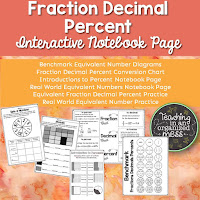
Fraction Decimal Percent--Equivalent Numbers Practice Freebies

I feel like it takes students all school year and then some to remember how to convert between fractions, decimals and percents.

In Texas, we start with generating equivalent numbers in 6th grade: the time when some teachers and students think math manipulatives and models are no longer needed. I strongly disagree. I struggled with math in school (which I believe is what makes me love teaching math now) and I don't ever remember working with math manipulatives or math models. No fraction models, algebra tiles, cuisenaire rods, etc. When I started teaching and understood the models myself, I understood the concepts so much better. The first time I saw dividing fractions modeled with cuisenaire rodes in grad school, I was blown away!

All this to say, don't think 6th graders (or older) are too old for models and manipulatives. Some students may not need them and other will. But don't make that call for them.

When it comes to generating equivalent forms of fractions, decimals, and percents, students have a hard time understanding that the numbers really are equivalent. They are different ways to tell the same story. So I always start with models.

At this point students have worked with fractions and decimals and have probably heard to percents, but don't understand what they are. I start with a mini presentation to get the conversation going about what percents are. (Click the link to make a copy to your Google Drive)


And we practice. Over and over and over again. I use notebook pages like this that students can refer to as they practice.

Practice starts simple. I write fraction, decimals, and percent on index cards, pull students to work in small group, give them so dry erase markers and start converting. They work the problems on the small group table and I get to see where students are running into problems.

Fraction Decimal and Percent conversion is a skill that students revisit all year long, so I need lots of different ways to keep students practicing. Download this sheet here  for more practice. 


Other Fraction, Decimal, Percent Resources


Wednesday, December 26, 2018

Moon Phases, Seasons, and Shadows TEKS 4.8C

5th grade science teachers in Texas need to spend some time reviewing/reteaching some 3rd and 4th grade science TEKS in addition to the 5th grade TEKS. 

Science TEKS 4.8C says "Collect and analyze data to identify sequences and predict patterns of change in shadows, seasons, and the observable appearance of the Moon over time."

This TEKS has been tested once in the last 4 years and it was over tides--which was dropped from the TEKS this year. It isn't enough for students to know what causes these events but they should be able to look over data and predict. 

Moon Phases
This video shows all the moon phases from 2017.  
  • Ask students what they notice and wonder after watching the video. Do they see a pattern after watching it?
  • Give students a calendar with some of the moon phases filled in for the month. Have them complete the calendar based on the pattern they see. 
Seasons 
Use this file to assess what students remember about the different seasons. There are 24 cards. Give each student one card and they can walk around the room meeting up with their classmates. When they meet another classmate, each students will share the characteristic on their card and discuss what seasons they believe it belongs in. At this point, they can switch cards and then find another partner. At the end of the activity, create a chart and have students place their cards in the correct season. 

Shadows
Students need to understand how shadows are formed (because light travels in a straight line and when light hits an object, that object may block the light) and they need to understand that shadows form a predictable pattern. You can put an object outside and predict where the shadow that object creates will be. 

This activity lets students practice where the shadow is. It also doubles as an activity for 5.8C which is about Earth's rotation. Place the page with the tree in a sheet protector. Have students label the time for each of the Sun's position. Then have them draw where the tree's shadow will be with a dry erase marker at any given time. 

__________________________________________________________________________

All three of these patterns can be summed up with this free foldable found in my TpT store. 


Saturday, November 10, 2018

Calculating Average Speed--FREE Resource

Math and Science are so closely connected, but students never believe it. Ever tried teaching a cross-curricular lesson, only to have students say "This isn't math/science/writing class!" Middle school students start to get a glimpse of how science needs math.

In the Texas Science Standards in 6th grade, students start to calculate average speed given time and distance measurements. Here are a few resources that may help students practice calculating average speed.

ENGAGE

Start by introducing the the formula for calculating average speed by having students hop across the room or take the students outside. Mark off a predetermined distance (like 20 meters, 50 meters...) and give pairs or groups of students a timer to collect their data.


EXPLAIN

Take the Engage activity to a whole new level. Students will need to go outside for this one. Mark off a predetermined distance (50-100 meters) and have students tiptoe, speed walk, and run while they time the members of their group and then calculate their average speed.


MINI-ASSESSMENT

Students should be able to read tables and graphs to calculate average speed. This mini-assessments helps you see if students are able to do that.


Download this for FREE here.

Sunday, August 19, 2018

Change in Science TEKS and Metamorphosis Foldable

The science TEKS have been streamlined this year. Our district has done a lot of work to make sure that teachers are aware of the changes and not teach old lessons without making sure they fit the streamlined TEKS.

If you haven't used the resources on Lead4ward and you teach in Texas, you should. I am constantly on this website for various resources, the one I am sharing with you today takes the old TEKS and compares them with the streamlined TEKS. To find it, go here and click on the appropriate side-by-side for your grade level.

One thing that 5th grade does not have a TEKS for anymore is complete and incomplete metamorphosis. However, if you look at this document it states "Impact: the term metamorphosis has been removed from the K-12 TEKS (implied it will be addressed in standards pertaining to life cycles of living organisms that undergo metamorphosis)". There is still a 3rd grade TEKS that discusses life cycles that can still be tested on the 5th grade STAAR. So...will it not be on the STAAR test? I think it is possible.

So, here is a science notebook foldable that goes with metamorphosis, available for free on my TPT store.

Sunday, June 14, 2015

STAAR Quick Reference Guides

This is a resource for Texas Teachers.

I do not think that TEA has a good place to find the TEKS. And I like to refer to the TEKS often and don't like to carry around a lot of papers.


Region 20 has a list of STAAR resources that include a Quick Reference Guide.

For 6th grade math, I carry this around glued in my notebook.


I love it. It has all the TEKS and lists Readiness and Supporting. So much easier to navigate then the TEA website. 

Related Posts Plugin for WordPress, Blogger...