Thursday, December 16, 2021

FREE Classifying Rational Numbers Lesson and Activities

How to Teach Classifying Rational Numbers?

I love teaching classifying rational numbers. I don’t know why I like it so much but I think part of the reason is that the students already know pieces of this lesson and I am just helping them connect things they’ve learned in math previously to this new skill.

Classifying Rational Numbers Lesson Preview

The best math lessons are the ones were students make connections to something they have learned before. Research shows that when students are able to make connections to things that they already know, then those new topics stick in their brain better.


This set of classifying rational number lessons has students use number lines and come up with their own definition of things like whole numbers, which they have been using since kindergarten.


This lesson plan was originally written to be used within a classroom that uses small groups. So you will see four days of lessons that should take 15 to 20 minutes each and then the teacher would pull small groups for intervention or extra practice on this topic. However, you could also condense the lesson into 2 to 3 days depending on the length of your class period. 


You can download the set of lessons here for free. The lesson plans are editable and there is also a set of activities that go with the lesson plans.


How to Practice Classifying Rational Numbers?


If you would like more ways to practice classifying rational numbers, I have tons of resources in my TPT store. I would use these additional resources for extra practice throughout the year, for homework, for substitute lesson plans, or for stations in a small group math classroom.
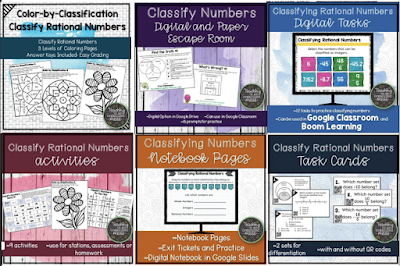


Classifying Rational Numbers Activities


Saturday, October 9, 2021

ZONK! A Math Review Game for Middle School Math-Have Fun Reviewing Math

A quick middle school math review game no technology required (Except a document camera and a projector)

Image of Group of Students talking and working
Middle School Math Review Game


What game can I use to review math with my middle school students?


Technology is great. But I do think that students need time in the classroom that require no technology. A teacher early in my career introduced me to the game ZONK. It helps students stay engaged in a review and creates some friendly competition.


You need some popsicle sticks. About 20 to 25 of them.  On about 18 of those popsicle sticks write the values 100, 200, 300, 400, 500, and 600. On the remaining popsicle sticks write the word ZONK! Place these popsicle sticks in a cup where students cannot see the writing on the sticks. 


You can review any topic that you want. You can use task cards, a cut up worksheet, a released state exam or problems that you write on index cards. You just need to be able to display them under a document camera. If you want to get really fancy, you can create slides in Google slides with problems on them and display that. 


Split your class into 2 to 4 groups. Each group will get a problem to work on displayed for everyone to see. Each group needs to work on the problem in case a group does not give a correct answer and they are able to steal their turn. Once a group gets the correct answer, they get to pick popsicle sticks out of the cup. They can pull out as many as they want and rack up the points. However as soon as they pull out the word ZONK, they lose all of the points they would have collected that round.


My classes loved the competition and it was fun to watch team come up with their strategies. Do they just draw one stick and be happy, or do they keep going and risk it. 


Have you used this game before? How did your students like it?

Sunday, January 3, 2021

Introduction to Inequalities with Desmos and Real-World Situations

 I think introducing inequalities is so much more interesting and fun than equations. There are so many more real-world situations that students can relate to. 

"Your mom says she will give you no more than $20 for lunch this week. How much money could she give you?"

"You need to be at least 48 inches to ride the roller coaster. How tall could you be and still ride it?"

"The elevator can hold up to 750 pounds. How much can the elevator hold?"

You can have some fun discussions with your students and even those students who struggle with math can participate because it is something they can relate to. It is  great way to help students build confidence. Math isn't just a set of steps and algorithms--its a way to explain the world around us. 

So this year, I was in the classroom because of lack of substitute teachers and got to start the inequality unit with some 6th graders. These are the two activities I used with students. (My campus currently has enough devices for every student.)

1. Desmos Inequalities on a Number Line

Have you used Desmos? You might know it as an online graphing calculator, but it is so much more. There are lessons on there that you can walk students through, see what they are doing in real-time, and give immediate feedback. 

The assignment I have linked has students place value on the number line with prompts like "a number less than 3." This starts students thinking about how there are multiple numbers that fit that prompt. One class would only every pick whole numbers and I had to push them to see 1.5 as a value they could select. 

Eventually this assignment shows students how we use a shaded number line to show all possible solutions. 

2. Google Slides Beginning Inequalities

Next, I had students look at some real-world statements on the board and place possible solutions on the number line. I had several students come up to the board and use a marker to mark their possible answers. Again, all students were able to participate because theses were situations they experienced in their daily lives. 

Now I know that when we get into solving and writing inequalities, that students may struggle. But by starting the unit with some low floor activities, the students can build their confidence and it is something I can continue to refer back on. 


Friday, September 18, 2020

Modeling Adding Integers with Algebra Tiles Free Google Drive Resource

 Virtual. Learning. 

Remote. Learning.

Distance. Learning.

Online. Learning.

Whatever your district calls it--this isn't easy. Not that I expected it to be. But this is just so much harder than I thought. There are so many decision to be made as new circumstances come up. I worry that our online learners aren't getting what they need. I worry about our in-class learners. I worry about my math teams and the stress they are under. I am constantly worrying. 

Hopefully in a year we can all look back on this time glad that school is filled with students talking, laughing, not on the computer all day long, etc. 

We've been working on our integer operations lessons. I filmed a video today with my favorite lesson that really needs students talking to work! I was just sitting at my desk talking to myself about the excitement that is integer operations <--that is not sarcasm. 

I love algebra tiles so much. When I first learned out them 7 years ago, I loved them. Where were these when I learned algebra, where all my math problems began!

If you aren't using algebra tiles or colored counters to teach integer operations--start now. 

This assignment has students model simple addition expressions, create zero pairs, and simplify the expression. 

Modeling adding integers with algebra tiles free google drive resource


Click here to copy the activity into your Google Drive. 

Modeling adding integers with algebra tiles free google drive resource


Sunday, September 6, 2020

Using Integer Vocabulary to Get Students to Talk in Math | Free Resource

I don't like just introducing new concepts in math without talking about real-world implications. When introducing integers, we start with talking about vocabulary that show positive and negative situations. 

Integers Vocabulary

On the day you introduce integers, display this slide to your class and ask them to pick one word with their group that means positive and one that mean negative. 

Having your students talk in math class is important. Not just to explain math, but to build skills of sharing ideas in respectful ways with their classmates. This is a low floor questions where most students will be able to find at least 1 word that they can explain as positive or negative. It is also important for ELLs to practice their academic vocabulary with their peers. 

Talking in math class doesn't always have to be about explaining how to solve a problem. This is still math talk! It will also help students be able to connect math class to outside the classroom. 

You could even extend this to a writing activity and have students write what about the words their groups talked about. 


Wednesday, September 2, 2020

Fraction Decimal Percent Google Slides Digital Assignment

 Are you are trying to figure out virtual learning and face-to-face learning at the same time? Is your school doing just virtual learning? No matter what your situations, the 2020-2021 school year will be one to remember. The first few weeks of school have been exhausting and overwhelming. 

I want to do what I can to help. I wish I could do more! 

This resource has students look at models and name the fraction, decimal, and percent modeled. 

Fraction Decimal Percent Models

Click here to download to the Free Activity

Fraction Decimal Percent Digital Task


Sunday, August 30, 2020

First Day of School Procedures: Organizing School Supplies

I originally posted this in 2015 and I'm reposting it because I dealing with school supplies is my second favorite part of the first day of school (after meeting the students). I know longer get to do it in my role as instructional coach but I still love school supplies. 

First Day of School Procedures Schools Supplies

Students come on the first day and we deal with supplies. If a student bought everything on our school supply list, it would fill several grocery bags. Some are class supplies and need to be taken up in an organized way.

Our students share 3 teachers all day long and stay with their homeroom. My team and I discuss before hand what we need for our classes. And then we each decide what to do with the rest. My first year teaching, I do not remember what I did. I do remember that it was a mess. I went back and looked at my teaching journal and from my first day of teaching I have this sketch.

First Day of School Procedures School Supplies

I wished someone had talked to me about collecting supplies on the first day, because I struggle with organization. (Have you seen the title of my blog?) After that first day, I realized I needed to do better and I have picked them up like this every since. I put baskets/boxes/tubs around the room on the first day of school with labels. After introductions, names, a quick overview of the day, we dig into supplies. I go down the list of supplies and ask students to get out one or two supplies at a time. If we are going to keep it in the classroom, I dismiss a few groups at a time to take it to the right spot. If they are going to keep it, I suggest a good way to store it, keep it, set it up, etc. I also give groups a Sharpie to write their names when necessary.

Then at the end of the day, I can go through all the baskets, and put the supplies away.

If the supply list calls for multiples of the same things, I have the students keep one and I take the other and store it in large plastic bags with their name on it. From experience, I have seen them lose the extra supplies before they have a chance to use them. Since these supplies are meant to least ALL year, I try to make that happen.

Since school supplies are my favorite, I love seeing so many brand new school supplies all at once! It is one of my favorite parts of the first day of school, especially since it is more organized then the first time.


Related Posts Plugin for WordPress, Blogger...